What’s the Big Deal About Getting This Right?
Picture this: You’re designing a steam boiler system and accidentally specify a pressure relief valve instead of a pressure safety valve. When an emergency happens, the valve might not open fast enough to prevent an explosion. On the flip side, using a pressure safety valve in a liquid system could cause damaging pressure waves that destroy your pipes.
For complete selection guidelines and cross-reference documentation on this product line, please consult our Rexroth pressure control valve equivalents.
This isn’t just technical nitpicking – it’s about safety, compliance, and protecting both people and equipment.
The Core Difference: Emergency vs. Process Control
The fundamental difference between PSV and PRV lies in their primary purpose:
Pressure Safety Valve (PSV): The Emergency Guardian
A PSV is your last line of defense against catastrophic failure. Think of it as the emergency brake in your car – you hope you never need it, but when you do, it better work perfectly and immediately.
PSVs are designed to:
- Prevent explosions and catastrophic equipment failure
- Protect human life, environment, and property
- Handle extreme emergency situations
- Work with gases and steam (compressible fluids)
Pressure Relief Valve (PRV): The Process Controller
A PRV is more like your car’s cruise control – it keeps things running smoothly within normal operating ranges. It’s designed to handle routine pressure variations, not emergencies.
PRVs are designed to:
- Maintain steady system pressure during normal operations
- Protect equipment from minor pressure increases
- Handle liquids (incompressible fluids)
- Allow for gradual pressure adjustments
How They Work: Pop Action vs. Proportional Opening
The way these valves open reveals their true nature:
PSV
When a PSV reaches its set pressure, it doesn’t gradually open – it “pops” wide open instantly”. This happens because of a special internal design feature called a “huddling chamber.”
Here’s how it works:
- Pressure builds up to the set point
- The valve disc lifts slightly
- High-pressure fluid rushes into the huddling chamber
- This creates a larger pressure area, multiplying the lifting force
- BANG! The valve slams open to maximum capacity
This instant, full opening is perfect for gases and steam because these fluids can build up pressure incredibly fast. You need maximum flow capacity immediately to prevent disaster.
PRV
PRVs open smoothly and proportionally. The higher the pressure goes above the set point, the more the valve opens. When pressure drops, the valve closes gradually. Learn the complete relief valve working principle.
This smooth action is ideal for liquids because:
- Liquids don’t compress much, so pressure builds slowly
- Sudden opening would cause harmful “water hammer” effects
- Only small amounts of liquid need to be released
- Gradual action prevents system shock
When to Use Each Type
Use PSV for:
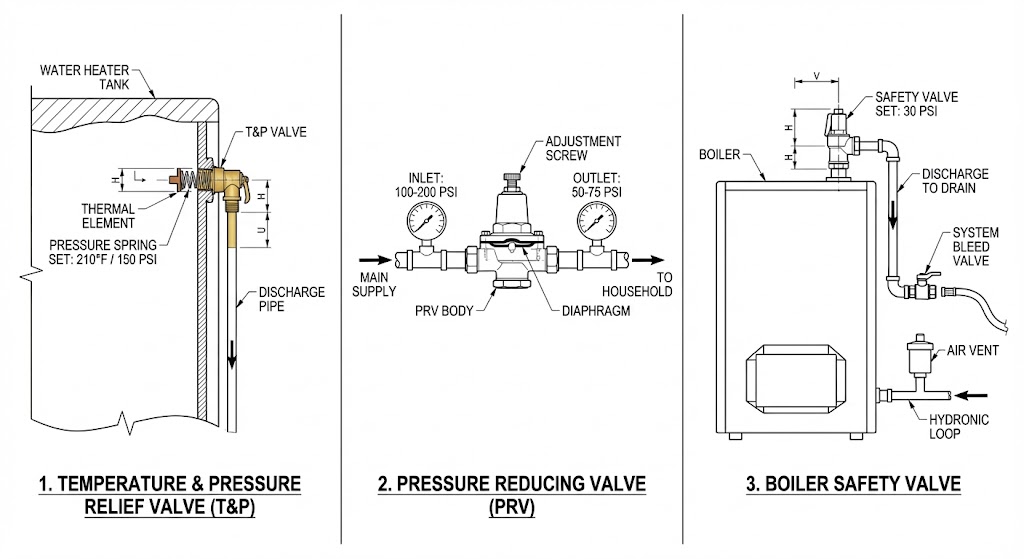
- Steam boilers (the classic application)
- Gas storage tanks
- Chemical reactors
- Any system with gases or steam
- High-risk emergency scenarios
Use PRV for:
- Hydraulic systems
- Liquid pipelines
- Thermal expansion protection
- Water systems
- Any system with liquids
See detailed safety relief valve types for specific applications
What the Standards Say: ASME and API Guidelines
Professional engineers don’t guess – they follow strict standards. The American Society of Mechanical Engineers (ASME) and American Petroleum Institute (API) provide clear definitions:
| Official Terminology | Description |
|---|---|
| Safety Valve (SV) | Fast-opening valve for gases/steam |
| Relief Valve (RV) | Proportional-opening valve for liquids |
| Safety Relief Valve (SRV) | Can work as either type depending on the application |
Key Performance Numbers You Need to Know
Set Pressure
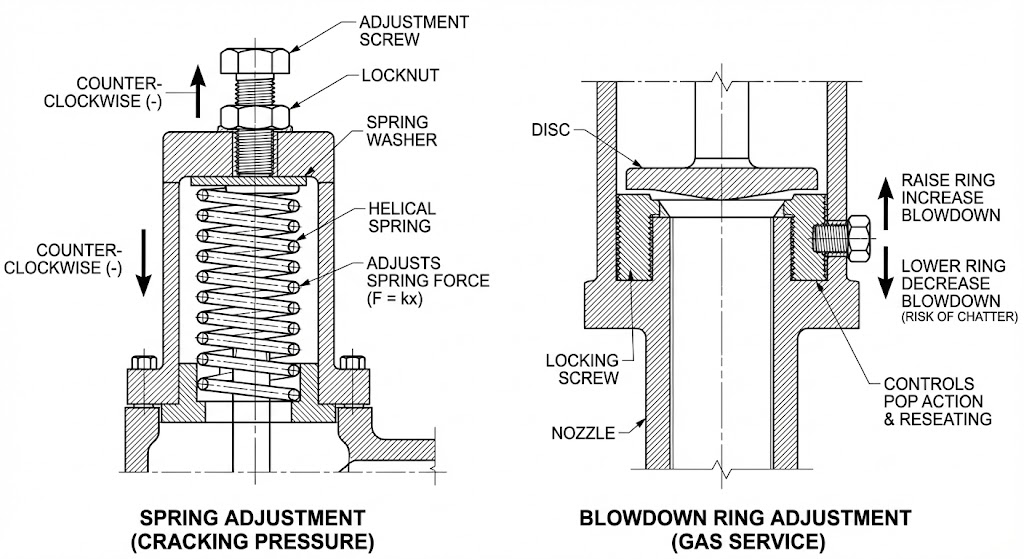
This is when the valve starts to open. For a single valve protecting a system, this must be at or below the Maximum Allowable Working Pressure (MAWP).
Overpressure Limits
- PSV systems: Usually limited to 10% above MAWP
- PRV systems: Can handle wider ranges, typically 15-30%
Blowdown
This is how much pressure drops before the valve closes again:
| Valve Type | Typical Blowdown Range | Control Level |
|---|---|---|
| PSV | 5-7% | Tight control |
| PRV | 15-30% or more | Wider range |
Common Mistakes to Avoid
- Using PRV for gas systems – Won’t open fast enough in emergencies
- Using PSV for liquid systems – Can cause damaging pressure waves
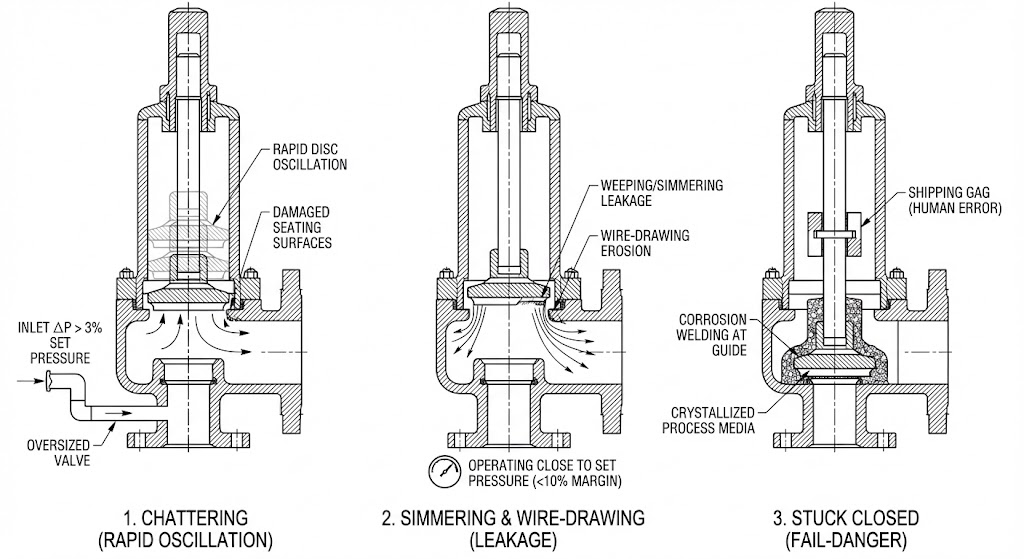
- Ignoring inlet pressure losses – Can cause valve chattering
- Wrong size calculations – Use API 520 for proper sizing
- Mixing up terminology – Always use precise ASME/API terms in documentation
Maintenance Considerations
PSV Maintenance:
- After any activation: Complete inspection required
- Spring testing: Critical for proper set pressure
- Seat examination: Check for damage from high-velocity gases
- Material check: High-temperature and corrosion resistance
PRV Maintenance:
- Regular leak testing: Ensure tight shutoff
- Smooth operation: Check for proportional opening
- Less critical: Can often continue operating after minor activations
- Annual inspection: Recommended but not always mandatory
Making the Right Choice
When selecting between PSV and PRV, ask yourself:
- What type of fluid? Gas/steam = PSV, Liquid = PRV
- Emergency or routine? Emergency = PSV, Routine = PRV
- How fast can pressure build? Fast = PSV, Slow = PRV
- What are you protecting? Life/property = PSV, Equipment = PRV
Cost and Brand Considerations
Quality pressure relief devices are investments in safety:
| Item | Price Range | Notes |
|---|---|---|
| PSV prices | $200-1,000+ | Depending on size and materials |
| PRV prices | $100-600+ | For standard applications |
| Trusted brands | LESER, Crosby, Farris | All ASME certified |
| Certification | ASME “UV” or “V” stamps | Essential for compliance |
The Bottom Line
The difference between PSV and PRV isn’t just technical jargon – it’s about choosing the right tool for the job. PSVs protect against disasters, while PRVs maintain smooth operations.
Gases and steam need PSVs for emergency protection
Liquids need PRVs for process control
Getting this choice right means safer operations, regulatory compliance, and protection of both people and equipment. When in doubt, consult with qualified engineers and always follow ASME/API standards.
Your pressure relief system is only as good as your understanding of when and how to use each component correctly. Make the right choice – lives and facilities depend on it.