Imagine turning a water faucet on and off, or switching the direction water flows through your garden hose. Directional valve control works similarly, but instead of water, it controls hydraulic oil or compressed air in machines. Understanding the role directional valves play is essential for system design
For complete selection guidelines and cross-reference documentation on this product line, please consult our Huade directional control valve series.
A directional control valve (DCV) is like a traffic controller for fluids. It decides where the fluid goes, when it stops, and how fast it moves. These valves are the “brain” of hydraulic and pneumatic systems, making everything from construction equipment to factory machines work properly.
Why Are Directional Valves So Important?
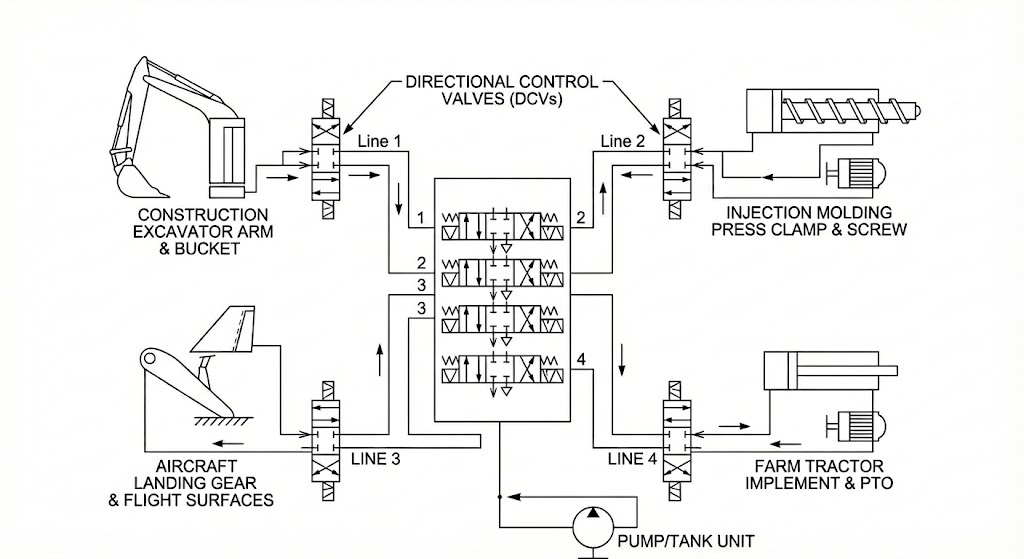
Think about an excavator digging a hole. The operator moves a joystick, and the bucket moves exactly where they want it to go. This happens because directional valves control the hydraulic oil flowing to different parts of the machine.
Without proper directional valve control, machines would be like cars without steering wheels – completely uncontrollable. These valves make precise movement possible in:
Construction Equipment
Excavators, bulldozers, cranes
Factory Machines
Injection molding, presses, automation
Aircraft Systems
Landing gear, flight controls
Farm Equipment
Tractors, harvesters, implements
How Do Directional Valves Work?
The basic idea is simple: a moving part inside the valve (called a spool) slides back and forth to open and close different pathways for the fluid.
Three Main Types of Internal Design
Spool Valves
Most common type. Unlike one-way valves that only prevent backflow, spool valves actively route fluid
The spool slides like a drawer to connect different ports
Can handle complex functions but has small leakage
Used in most industrial applications
Poppet Valves
Work like a cork in a bottle
Almost zero leakage when closed
Perfect for holding heavy loads in place
Limited to simple on/off functions
Rotary Valves
The spool rotates instead of sliding
Compact design
Often used for manual controls
Understanding Valve Symbols and Numbers
Directional valves are described using numbers like “4/2” or “5/3.” Here’s what these mean:
- First number: How many ports (connections) the valve has
- Second number: How many positions the valve can be in
Common Valve Types
2/2 Valve: 2 ports, 2 positions (simple on/off)
- Like a light switch for fluid flow
- Used to start or stop flow completely
4/2 Valve: 4 ports, 2 positions
- Controls double-acting cylinders (pistons that can push and pull)
- Can make a cylinder extend or retract
4/3 Valve: 4 ports, 3 positions
Has a center position where different things can happen:
- Closed center: Locks the cylinder in place
- Open center: Lets the pump rest (saves energy)
- Float center: Allows free movement
Types of Directional Valve Control
1. On-Off Control (Bang-Bang)
This is the simplest type – like a light switch that’s either on or off.
Good For:
- Basic start/stop functions
- Simple hydraulic circuits
- Safety shutoffs
Not Good For:
- Smooth, precise control
- Variable speed applications
- Sensitive positioning
2. Proportional Control
This is like a dimmer switch for lights – you can adjust how much flow you want.
How it works
The valve opening changes based on an electrical signal
Best for
Controlling speed and force smoothly
Cost
Medium price range
Used in
Construction equipment, industrial machines
3. Servo Control
This is the Ferrari of valve control – extremely precise and fast.
How it works
Uses advanced feedback systems to make tiny adjustments
Best for
Ultra-precise positioning and high-speed operations
Cost
Expensive but worth it for critical applications
Used in
Aircraft, precision manufacturing, robotics
How Valves Are Controlled
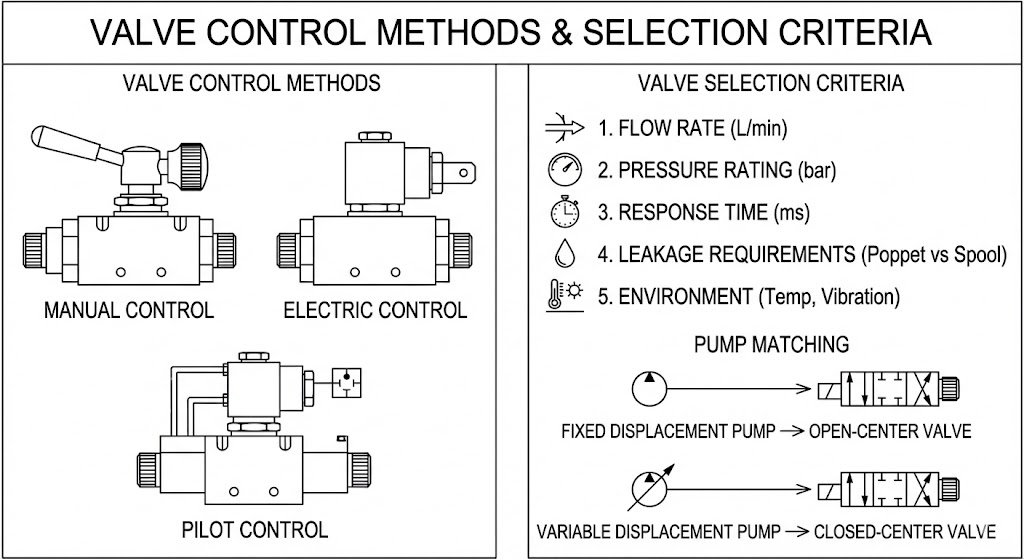
Manual Control
Operated by hand levers or knobs
Simple and reliable
Used when automation isn’t needed
Electric Control
Controlled by electrical signals
Fast response (milliseconds)
Easy to connect to computers
Pilot Control
Uses hydraulic or air pressure
Good for very large valves
Slightly slower than electric
New Technologies: Shape memory alloys (metals that change shape when heated), digital communication systems, and smart sensors built into the valve are becoming more common.
Choosing the Right Valve
Key Things to Consider
1. Flow Rate
How much fluid needs to pass through per minute. Bigger applications need valves that can handle more flow.
2. Pressure Rating
Maximum pressure the valve can safely handle. Always choose a valve rated higher than your system pressure.
3. Response Time
How fast the valve needs to switch. Critical for safety systems and precision applications.
4. Leakage Requirements
Some applications can’t tolerate any leakage. Poppet valves are best for zero-leakage applications.
5. Environment
Temperature extremes, vibration, corrosive chemicals. Some valves are built for harsh conditions.
Matching Valves to Pumps
The valve’s center position must work well with your pump type:
- Fixed displacement pumps: Need open-center valves to rest when not working
- Variable displacement pumps: Work well with closed-center valves for energy savings
Common Applications
Construction Equipment
Excavators
Use multiple proportional valves to control:
- Boom movement (up/down)
- Stick movement (in/out)
- Bucket rotation
- Track movement
The operator’s joystick movements are converted to electrical signals that control these valves precisely. These systems also use check valves to prevent backflow.
Bulldozers
Use directional valves to control:
- Blade angle and height
- Track speed and direction
- Ripper operation
Industrial Manufacturing
Injection Molding Machines
Use servo valves for:
- Precise plastic injection speed
- Mold closing force
- Part ejection timing
Hydraulic Presses
Use directional valves to:
- Control pressing force
- Hold pressure during forming
- Quick return stroke for productivity
Aircraft Systems
Landing Gear
Uses multiple valves with safety interlocks:
- Gear extension/retraction
- Gear door operation
- Emergency backup systems
Maintenance and Troubleshooting
Common Problems
1. Valve Sticking
Cause: Dirty oil, worn parts, or contamination
Solution: Clean the system, replace filters, check for proper oil grade
2. Internal Leakage
Cause: Worn valve parts or damaged seals
Symptoms: Slow or drifting movement, overheating
Solution: Rebuild or replace the valve
3. External Leakage
Cause: Damaged seals or loose connections
Solution: Replace seals, check torque on fittings
Preventive Maintenance
- Keep It Clean: Use proper filtration and change filters regularly
- Keep It Cool: Monitor temperature and use coolers if needed
- Keep It Dry: Prevent water contamination
- Monitor Performance: Watch for changes in speed or response
Future Trends in Directional Valve Control
Smart Valves
Modern valves are getting smarter with:
- Built-in sensors that monitor performance
- Self-diagnostic capabilities
- Automatic adjustment for optimal performance
- Wireless communication with control systems
Energy Efficiency
New designs focus on:
- Reducing pressure losses
- Recovering energy from moving loads
- Variable flow control to match demand
- Better insulation and cooling
Digital Integration
- IoT Connectivity: Valves that connect to the internet for remote monitoring
- Predictive Maintenance: AI systems that predict when maintenance is needed
- Digital Twins: Computer models that simulate valve behavior
Market Trends and Industry Growth
The global directional valve control market is growing rapidly, expected to reach $15.5 billion by 2032. This growth is driven by:
- Industrial Automation: More factories using automated systems
- Construction Boom: Infrastructure projects worldwide
- Renewable Energy: Wind turbines and solar tracking systems
- Agricultural Mechanization: Advanced farming equipment
Key Players
Major manufacturers include: Bosch Rexroth, Parker Hannifin, Eaton, Danfoss, Moog, and ATOS.
Valve Selection Checklist
- Determine flow requirements
- Check pressure ratings
- Consider response time needs
- Evaluate environmental conditions
- Match center position to pump type
- Budget for control electronics
- Plan for maintenance access
Common Specifications to Request
- Flow coefficient (Cv)
- Maximum operating pressure
- Response time
- Leakage rates
- Temperature range
- Mounting configuration
- Control voltage requirements
Conclusion
Directional valve control is essential for making machines work smoothly and efficiently. Whether you’re operating construction equipment, running a factory, or flying an airplane, these valves are working behind the scenes to make precise control possible.
Understanding the basics helps you:
- Choose the right valve for your application
- Maintain systems properly
- Troubleshoot problems quickly
- Make informed purchasing decisions
As technology advances, directional valves are becoming smarter, more efficient, and easier to maintain. The future promises even better control, lower costs, and improved reliability.
Remember: the right directional valve control system can make the difference between a machine that barely works and one that performs flawlessly for years. Take time to understand your needs, choose quality components, and maintain them properly – your equipment will thank you with reliable, efficient operation.
Understanding directional valve control doesn’t have to be complicated. Start with the basics, understand your application needs, and choose components that match your requirements and budget. With proper selection and maintenance, these essential components will provide years of reliable service.