These valves are found everywhere in industry – from oil refineries to power plants, chemical factories to food processing facilities. They prevent explosions, equipment damage, and keep workers safe.
For complete selection guidelines and cross-reference documentation on this product line, please consult our pressure relief and reducing valve specifications.
Why Do We Need Different Types?
Not all fluids behave the same way. Water and oil are liquids that don’t compress much. Steam and gas can compress and expand quickly. This difference means we need different valve types for different jobs.
The Three Main Categories
1. Safety Valves (SVs)
Best for: Steam and gases (compressible fluids)
Safety valves have a “pop action” – they open quickly and fully when pressure reaches the set point. This rapid opening is perfect for gases and steam because these fluids expand fast and need quick pressure relief. Understand the difference between PSV and PRV.
- Opens fast and completely
- Uses a special chamber design to stay open
- Perfect for boilers and steam systems
- Prevents pressure spikes
2. Relief Valves (RVs)
Best for: Water and oils (incompressible fluids)
Relief valves open gradually as pressure increases. They’re like a faucet that opens slowly – the higher the pressure, the more it opens. This gentle action prevents water hammer and system shock in liquid systems.
- Opens gradually with rising pressure
- Smooth, controlled pressure relief
- Ideal for liquid systems
- Prevents system damage from sudden pressure changes
3. Safety Relief Valves (SRVs)
Best for: Mixed systems or general use
These versatile valves can work like safety valves OR relief valves, depending on what fluid they’re handling. They’re the “Swiss Army knife” of pressure relief valves.
- Pop action for gases
- Gradual opening for liquids
- One valve for multiple applications
- Cost-effective for varied systems
Two Main Design Types
Spring-Loaded Valves
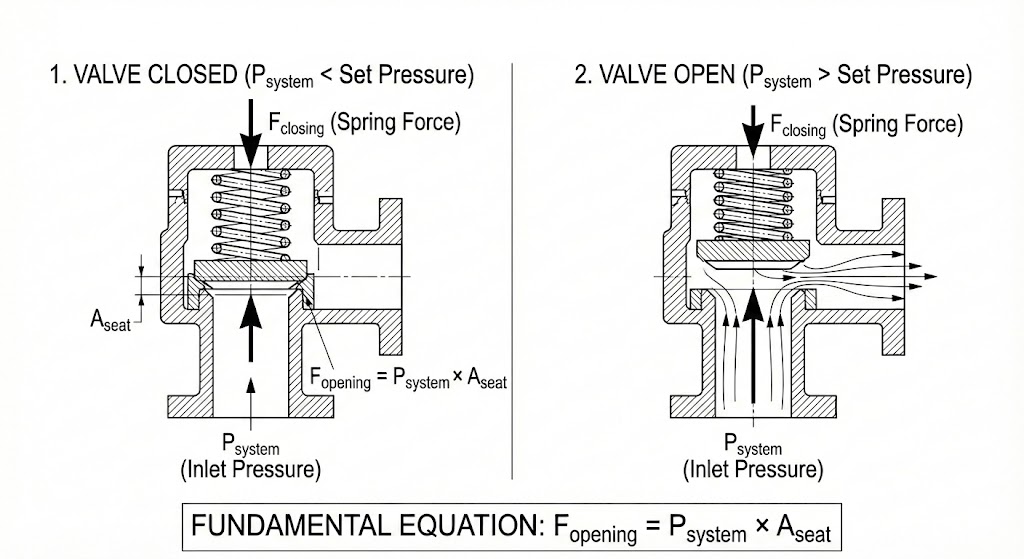
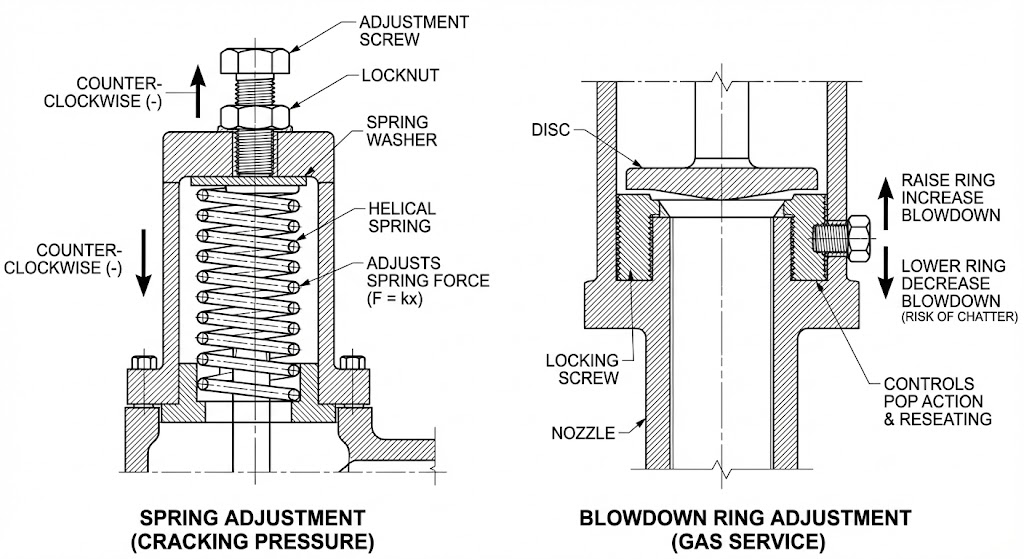
How they work: A strong spring holds the valve closed. When pressure overcomes the spring force, the valve opens.
Advantages:
- Simple design
- Lower cost
- Very reliable
- Easy to maintain
- Works in dirty conditions
Disadvantages:
- Can leak slightly before opening (called “simmering”)
- Affected by back pressure
- Need safety margin in operation
Best for: Most standard applications, standalone equipment, budget-conscious projects
Two Sub-types:
Conventional Spring-Loaded:
- Spring housing connects to valve outlet
- Sensitive to back pressure
- Good for systems with low back pressure (under 10%)
Balanced Bellows:
- Uses a bellows to block back pressure effects
- Works with higher back pressure (up to 40-50%)
- Bellows can wear out over time
Pilot-Operated Safety Valves (POSVs)
How they work: A small pilot valve controls a larger main valve. System pressure pushes down on a piston. When the pilot opens, it releases this pressure and the main valve opens quickly.
Advantages:
- Excellent sealing (can operate at 98% of set pressure)
- Not affected by back pressure
- Very precise control
- Good for high-capacity systems
Disadvantages:
- More complex design
- Higher initial cost
- Needs cleaner fluids
- More maintenance required
Best for: High-pressure systems, flare networks, applications where tight sealing is critical
Quick Comparison Table
| Feature | Spring-Loaded | Pilot-Operated |
|---|---|---|
| Cost | Lower | Higher |
| Complexity | Simple | Complex |
| Sealing | Good (90% set pressure) | Excellent (98% set pressure) |
| Back Pressure | Sensitive | Not affected |
| Maintenance | Easy | More involved |
| Best Use | General applications | High-performance needs |
Special Purpose Valve Types
Vacuum Relief Valves
Prevent tanks from collapsing when internal pressure drops too low. They let air in rather than letting pressure out.
Temperature & Pressure Valves
Open when either temperature OR pressure gets too high. Common in water heaters and small boilers.
Rupture Discs
These don’t reclose – they burst open at a set pressure and need replacement. Used for emergency situations requiring instant, high-volume relief.
How to Choose the Right Type
Ask These Questions:
-
What kind of fluid?
- Gas/steam → Safety valve or SRV
- Liquid → Relief valve or SRV
-
What’s your operating pressure?
- Need tight sealing near set pressure → Pilot-operated
- Standard operation with margin → Spring-loaded
-
Is there back pressure?
- High back pressure → Pilot-operated or balanced bellows
- Low back pressure → Conventional spring-loaded
-
What’s your budget?
- Cost-sensitive → Spring-loaded
- Performance-critical → Pilot-operated
-
How clean is your fluid?
- Dirty/sticky fluids → Spring-loaded
-
Clean fluids → Either type works
[For adjustable options, see our adjustable relief valve guide.]
Industry Applications
Oil & Gas
- Refineries: Mixed valve types for different processes
- Pipelines: Spring-loaded for simplicity and reliability
- Offshore platforms: Pilot-operated for space and performance
Chemical Processing
- Reactors: Safety valves for gas reactions
- Storage tanks: Relief valves for liquid storage
- Heat exchangers: SRVs for mixed-phase systems
Power Generation
- Boilers: Safety valves for steam systems
- Cooling systems: Relief valves for water circuits
- Gas turbines: Specialized high-temperature valves
Food & Beverage
- Steam systems: Safety valves for cooking/sterilization
- Storage tanks: Relief valves for liquid products
- Pressure vessels: SRVs for mixed applications
Common Problems and Solutions
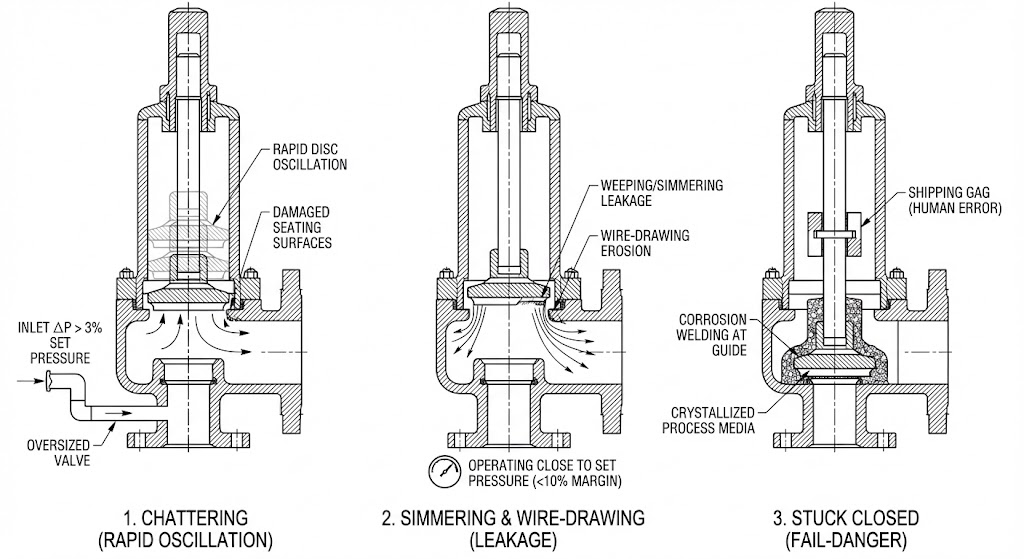
Chattering (Rapid Opening/Closing)
Problem: Valve opens and closes rapidly, causing damage
Causes: Oversized valve, poor piping design, high back pressure
Solutions: Better piping, smaller valve, or pilot-operated design
Simmering (Early Leakage)
Problem: Valve leaks before reaching set pressure
Causes: Operating too close to set pressure, damaged seats
Solutions: Lower operating pressure, repair valve, use pilot-operated
Won’t Open
Problem: Valve doesn’t open at set pressure
Causes: Stuck parts, wrong spring, calibration error
Solutions: Maintenance, recalibration, component replacement
Future Trends
Smart Valves
New valves include sensors and wireless communication to monitor performance in real-time. This helps predict maintenance needs and improve safety.
Advanced Materials
New materials handle extreme temperatures, corrosive chemicals, and challenging applications like hydrogen service.
Digital Integration
Valves are becoming part of larger plant control systems, providing data to help optimize operations and prevent problems.
Key Takeaways
- Match valve type to fluid type: Spring-loaded for general use, pilot-operated for high performance
- Consider your operating conditions: Pressure, temperature, back pressure, and fluid cleanliness
- Balance cost vs. performance: Initial cost vs. long-term efficiency and reliability
- Follow industry standards: ASME, API, and ISO provide guidance for safe selection and installation
- Plan for maintenance: Simple designs are easier to maintain, complex designs may offer better performance
Conclusion
Choosing the right safety relief valve type is crucial for plant safety and efficiency. Spring-loaded valves work well for most applications and offer simplicity and cost-effectiveness. Pilot-operated valves provide superior performance for demanding applications but require more maintenance and higher initial investment.
Understanding your specific needs – fluid type, operating conditions, performance requirements, and budget – will guide you to the best choice for your application. When in doubt, consult with valve manufacturers and safety engineers to ensure you select the right protection for your system.
Remember: safety relief valves are your last line of defense against overpressure. Investing in the right type and proper maintenance can prevent catastrophic failures and save lives.