For complete selection guidelines and cross-reference documentation on this product line, please consult our Rexroth replacement hydraulic products guide.
When choosing between a 2 way valve vs 3 way valve for your system, understanding their key differences can save you thousands in installation costs and prevent costly mistakes. Whether you’re working on plumbing, HVAC, or industrial applications, this comprehensive guide breaks down everything you need to know about these essential flow control devices.
What Are 2-Way and 3-Way Valves?
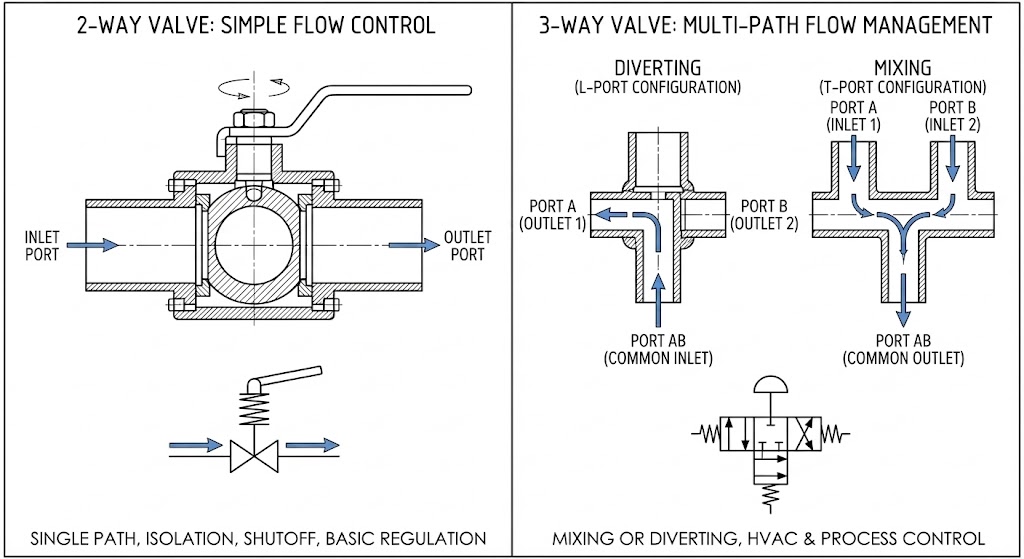
2-Way Valves: Simple Flow Control
A 2-way valve controls fluid flow through a single path with two ports:
- Inlet port: Where fluid enters
- Outlet port: Where fluid exits
Ball, plug, or gate mechanisms let the valve act like a door—fully open, closed, or partially open for controlled flow. These valves excel in 2 way valve plumbing uses like isolation, shutoff, and basic flow regulation.
Key Technical Specs:
- Cv Range: 0.1 to 500+ depending on size
- Pressure Drop (ΔP): Typically 5-15 PSI at full flow
- Materials: Brass (residential), stainless steel (industrial), PVC (chemical)
3-Way Valves: Multi-Path Flow Management
A 3-way valve manages flow between three ports for mixing or diverting applications:
- Port A: First inlet/outlet
- Port B: Second inlet/outlet
- Port AB: Common port
These valves come in L-port (diverting) and T-port (mixing) configurations, making them ideal for 3 way mixing valve applications in HVAC and process control.
Key Technical Specs:
- Cv Range: Usually 20-30% lower than equivalent 2-way valves
- Pressure Drop (ΔP): Typically 10-25 PSI due to complex flow paths
- Materials: Primarily brass and stainless steel for durability
Technical Performance Comparison
Flow Coefficient (Cv) Analysis
The flow coefficient (Cv) measures how much water (in GPM) flows through a valve with a 1 PSI pressure drop:
| Valve Size | 2-Way Cv | 3-Way Cv | Efficiency Loss |
|---|---|---|---|
| 1/2″ | 8.5 | 6.0 | 29% |
| 1″ | 25 | 18 | 28% |
| 2″ | 90 | 65 | 28% |
| 3″ | 210 | 150 | 29% |
Key Insight:
3-way valves typically have 25-30% lower Cv values due to internal flow restrictions.
Pressure Drop Tolerance (ΔP)
2-Way Valves
Standard Range: 5-150 PSI
High-Pressure Options: Up to 6,000 PSI
Optimal Performance: 10-50 PSI range
3-Way Valves
Standard Range: 10-125 PSI
Limitation: Complex internal geometry reduces pressure tolerance
Optimal Performance: 15-75 PSI range
Material Compatibility Guide
| Application | 2-Way Materials | 3-Way Materials | Best Choice |
|---|---|---|---|
| Residential Water | Brass, Bronze | Brass | Brass (both types) |
| Industrial Steam | Stainless Steel 316 | Stainless Steel 316 | SS 316 (both types) |
| Chemical Processing | Hastelloy, PTFE-lined | Limited options | 2-way preferred |
| Food & Beverage | SS 316L, Sanitary | SS 316L | Both suitable |
| Corrosive Media | PVC, CPVC, PVDF | Mainly PVC | 2-way offers more options |
When to Choose Each Valve Type
2-Way Valve Applications
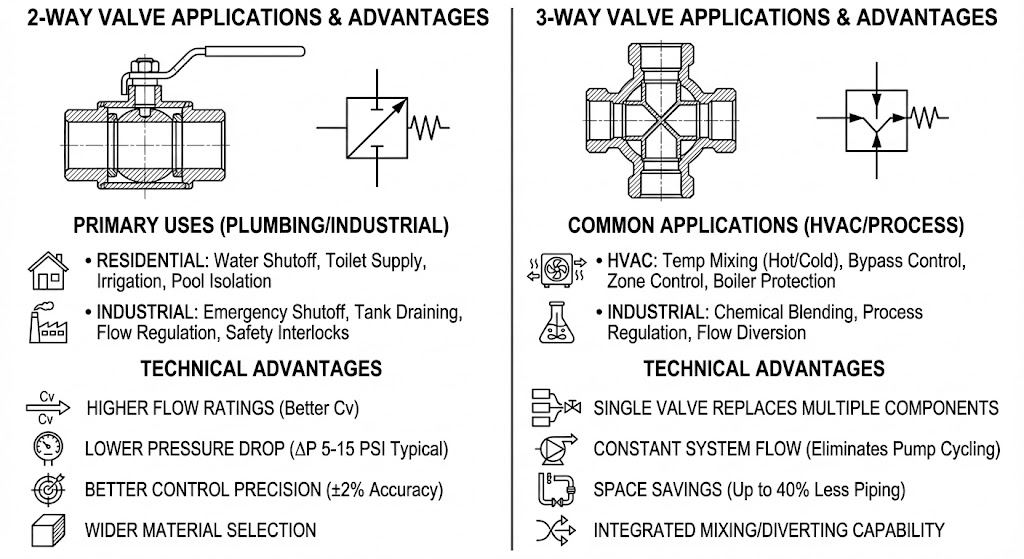
Primary 2 Way Valve Plumbing Uses:
Residential Systems:
- Water shutoff valves (main lines)
- Toilet supply control
- Irrigation zone control
- Pool equipment isolation
Industrial Applications:
- Emergency shutoff systems
- Tank isolation and draining
- Simple flow regulation
- Safety interlocks
Technical Advantages:
- Higher Cv ratings for better flow
- Lower pressure drop (5-15 PSI typical)
- Better control precision (±2% flow accuracy)
- Wider material selection for specialized media
3-Way Valve Applications
Common 3 Way Mixing Valve Applications:
HVAC Systems:
- Temperature control: Mixing hot/cold water for precise output
- Bypass control: Maintaining constant pump flow
- Zone control: Directing heating/cooling to different areas
- Boiler protection: Preventing low-temperature return water
Industrial Processes:
- Chemical blending: Precise ratio mixing
- Temperature regulation: Process fluid conditioning
- Flow diversion: Sending fluid to different process stages
- Bypass loops: Equipment protection and maintenance
Technical Advantages:
- Single valve replaces multiple components
- Constant system flow (eliminates pump cycling)
- Space savings (up to 40% less piping)
- Integrated mixing/diverting capability
Detailed Cost Analysis
Initial Investment Comparison
| Valve Size | 2-Way Cost | 3-Way Cost | Price Difference |
|---|---|---|---|
| 1/2″ | $45-85 | $120-180 | +150% |
| 1″ | $85-150 | $200-350 | +140% |
| 2″ | $200-400 | $500-900 | +130% |
| 3″ | $450-800 | $900-1,600 | +120% |
System-Level Cost Impact
2-Way Valve Systems
Components needed: 2-4 valves for mixing applications
Additional costs: Extra piping, fittings, controls
Installation time: 3-5 hours for complex setups
Total system cost: Often 20-40% higher for multi-path applications
3-Way Valve Systems
Components needed: Single valve handles multiple functions
Space savings: Reduced piping runs
Installation time: 1-2 hours typical
Total system cost: Lower despite higher valve cost
Total Cost of Ownership (TCO) – 10 Years
| System Type | 2-Way Setup | 3-Way Setup | Savings |
|---|---|---|---|
| Initial Cost | $800 | $1,200 | -$400 |
| Installation | $600 | $300 | +$300 |
| Maintenance | $400 | $250 | +$150 |
| Energy Costs | $1,500 | $1,200 | +$300 |
| Total TCO | $3,300 | $2,950 | +$350 |
Advanced Selection Criteria
Flow Pattern Requirements
Variable Flow Systems (Choose 2-Way)
- VFD pump systems
- Demand-based applications
- Energy-conscious designs
- Precise flow control needs
Constant Flow Systems (Choose 3-Way)
- Fixed-speed pumps
- Bypass requirements
- Temperature control loops
- Process stability critical
Control System Integration
2-Way Valve Control
Actuator Types: Electric (24V-240V), Pneumatic (3-15 PSI), Manual
Control Signals: 0-10V, 4-20mA, Digital (Modbus, BACnet)
Response Time: 15-90 seconds typical
Positioning Accuracy: ±1-2%
3-Way Valve Control
Actuator Types: Same as 2-way but often requires more torque
Control Logic: More complex (mixing ratios, diverting sequences)
Response Time: 30-120 seconds due to larger actuators
Positioning Accuracy: ±2-5% due to complexity
Installation Best Practices
Sizing Guidelines
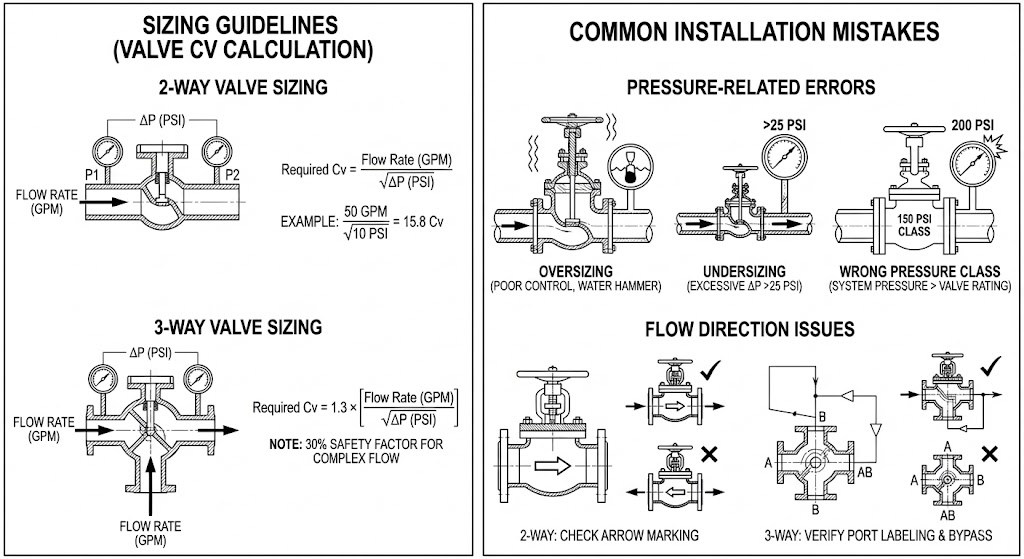
2-Way Valve Sizing
Example: 50 GPM flow with 10 PSI drop requires Cv = 50/√10 = 15.8
3-Way Valve Sizing
Note: 30% safety factor accounts for complex flow patterns
Common Installation Mistakes
Pressure-Related Errors:
- Oversizing: Causes poor control, water hammer
- Undersizing: Creates excessive pressure drop (>25 PSI)
- Wrong pressure class: Using 150 PSI valve in 200 PSI system
Flow Direction Issues:
- 2-Way: Check arrow marking (if directional)
- 3-Way: Verify port labeling matches system design
- Bypass setup: Ensure proper flow path configuration
Maintenance and Troubleshooting
Preventive Maintenance Schedule
2-Way Valves
- Monthly: Visual inspection for leaks
- Quarterly: Exercise valve through full range
- Annually: Replace packing/seals
- 3 Years: Full actuator service
3-Way Valves
- Monthly: Check all three ports for leaks
- Quarterly: Verify proper mixing/diverting ratios
- Annually: Service all seals and actuator
- 2 Years: Internal inspection (if accessible)
Performance Troubleshooting
Common 2-Way Issues:
- Reduced flow: Worn seat, debris blockage
- Leakage: Packing failure, seat wear
- Control problems: Actuator calibration, feedback issues
Common 3-Way Issues:
- Poor mixing: Internal wear, actuator positioning
- Flow imbalance: Partial blockage in one path
- Temperature variation: Seat leakage between ports
Future-Proofing Your System
Emerging Technologies
Smart Valve Integration:
- IoT sensors: Flow, pressure, temperature monitoring
- Predictive maintenance: AI-driven failure prediction
- Remote control: Cloud-based valve management
- Energy optimization: Real-time efficiency monitoring
Regulatory Considerations
Industry Standards:
- ASME B16.34: Pressure-temperature ratings
- API 598: Testing standards
- NSF/ANSI 61: Drinking water applications
- 3-A Sanitary: Food and beverage applications
Quick Decision Framework
Choose 2-Way Valves When:
- Simple on/off or throttling control needed
- Variable flow system with VFD pumps
- Budget constraints prioritize low initial cost
- Single fluid path sufficient
- High precision control required (±1-2%)
Choose 3-Way Valves When:
- Mixing or diverting functionality needed
- Constant flow system design
- Space limitations restrict multiple valves
- Temperature control applications
- System simplification preferred over cost
Conclusion: Making the Right Choice
The 2 way valve vs 3 way valve decision ultimately depends on your specific application requirements:
2-way valves excel in simple, cost-effective applications where precise single-path control is needed. With higher Cv ratings and lower pressure drops, they’re ideal for basic flow control and isolation.
3-way valves shine in complex systems requiring mixing, diverting, or temperature control. Despite higher initial costs, they often provide better total cost of ownership in multi-path applications.
Key Selection Factors:
- Flow requirements: Variable vs. constant flow systems
- Space constraints: Available room for piping and components
- Budget: Initial cost vs. total system cost
- Maintenance: Available expertise and service frequency
- Performance needs: Control precision vs. functionality
For 3 way mixing valve applications in HVAC or process control, the investment typically pays off through simplified installation and improved system performance. For 2 way valve plumbing uses in residential or simple industrial applications, the lower cost and proven reliability make them the smart choice.
Remember: the best valve isn’t always the most sophisticated—it’s the one that reliably meets your system requirements while providing the best long-term value. When in doubt, consult with valve engineers or experienced contractors who can evaluate your specific application and recommend the optimal solution.