The best hydraulic oil for axial piston pumps is a premium anti-wear (AW) mineral or synthetic fluid conforming to DIN 51524 Part 2 (HLP) or Part 3 (HVLP) standards, typically formulated in an ISO VG 46 viscosity grade with an optimum operating viscosity range between 16 and 36 centistokes (cSt).
Operating an axial piston pump at working pressures up to 350–400 bar requires hydraulic fluids with high shear stability, rapid air release, and strict particulate cleanliness certified to ISO 4406 18/16/13 or better. Selecting the correct fluid specification directly dictates the volumetric efficiency and service life of Huade, Rexroth, and Parker axial piston pumps.
Fluid Film Thickness and Lubrication Boundary Conditions
High-pressure axial piston pumps rely on full-fluid hydrodynamic and hydrostatic lubrication films to separate moving metal surfaces under severe mechanical loading. Critical boundary interfaces include:
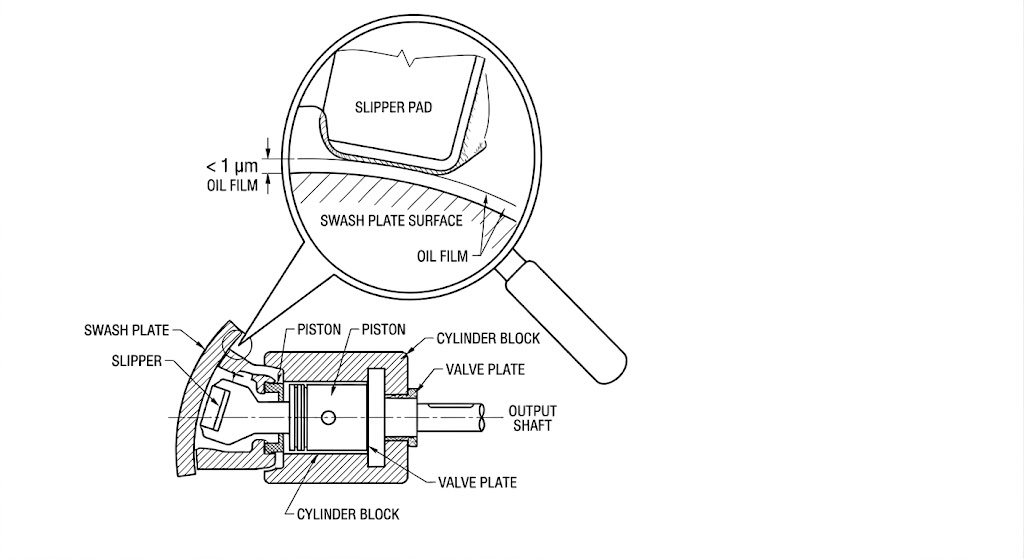
- Slipper Pad to Swashplate Interface: Hydrostatic pressure feeds oil through micro-orifices in the piston to create a 1 to 3 micron fluid film beneath the slipper pad.
- Piston to Cylinder Bore Interface: Reciprocating pistons generate hydrodynamic wedge pressures to prevent metal-to-metal scuffing against alloy-steel cylinder walls.
- Cylinder Barrel to Valve Port Plate Interface: Precision micro-gaps prevent internal bypass leakage while supporting the rotating barrel assembly.
If operating viscosity falls below 10 cSt, hydrodynamic film breakdown occurs, resulting in adhesive wear, surface galling, and rapid pump seizure. Conversely, excessively viscous fluid (above 1,000 cSt during cold starts) induces fluid starvation and inlet cavitation, eroding cylinder port plates.
Viscosity Selection and Operating Temperature Ranges
Selecting the correct ISO Viscosity Grade (VG) depends on ambient starting temperatures and steady-state reservoir operating temperatures.
*Engineering Guideline: Standard industrial hydraulic power units operating indoors between 45°C and 55°C achieve peak mechanical-volumetric efficiency when utilizing ISO VG 46 hydraulic fluids.*
Zinc-Based vs. Ashless Anti-Wear Formulations
Anti-wear (AW) additive chemistries are classified into two primary metallurgical formulations: Zinc-Based (ZDDP) and Ashless (Zinc-Free).
1. Zinc-Based Formulations (ZDDP)
Zinc dialkyldithiophosphate (ZDDP) thermally decomposes under extreme contact pressure to form a sacrificial iron-phosphate boundary layer on sliding steel surfaces.
- Advantages: Superior thermal film strength, low initial cost, and excellent protection for hardened steel piston-cylinder interfaces.
- Limitations: Zinc compounds can attack yellow metals (bronze slipper pads and bronze-bushed cylinder barrels) in the presence of water contamination above 0.05%.
2. Ashless (Zinc-Free) Formulations
Ashless hydraulic oils replace metal salts with sulfur-phosphorus organic esters.
- Advantages: Outstanding hydrolytic stability, complete compatibility with bronze alloy bushings, and zero sludge formation across ultra-fine (3-micron) return line filters.
- Limitations: Higher procurement cost and sensitivity to fluid cross-contamination.
ISO 4406 Oil Cleanliness Standards for Piston Pumps
Solid particulate contamination is the primary mechanism of premature displacement loss in axial piston pumps. Silt particles between 3 and 10 microns bridge internal lubrication clearances, causing accelerated three-body abrasive erosion.
High-pressure axial piston pumps require fluid cleanliness certified to ISO 4406 18/16/13:
- 18: Maximum 2,500 particles per mL larger than 4 μm.
- 16: Maximum 640 particles per mL larger than 6 μm.
- 13: Maximum 80 particles per mL larger than 14 μm.
Filtration Protocol: Fresh hydraulic oil delivered in commercial 200-liter barrels typically exhibits contamination codes of ISO 4406 21/19/16, which is completely unacceptable for high-pressure piston pumps. New oil must always be pre-filtered into the reservoir through an offline filtration cart equipped with filter elements rated at βx(c) ≥ 1000.
OEM Fluid Specifications and Industrial Certification Standards
To verify fluid thermal-shear stability under severe cyclic pressures, hydraulic oil must comply with standardized OEM pump durability testing specifications:
- Bosch Rexroth RDE 90235: Severe axial piston pump performance evaluation testing fluids at operating pressures up to 500 bar and reservoir temperatures up to 90°C.
- DIN 51524 Part 2 (HLP): Minimum quality standard for mineral-oil-based hydraulic fluids with anti-corrosion, anti-oxidation, and anti-wear properties.
- DIN 51524 Part 3 (HVLP): Premium fluids containing Shear-Stable Viscosity Index (VI) Improvers, ensuring a minimum Viscosity Index of 140 for mobile equipment operating across wide temperature differentials.
- Parker Hannifin (Denison) HF-0: Comprehensive hybrid validation standard certifying compatibility for mixed piston and vane pump hydraulic circuits.
Hydraulic Fluid Maintenance and Replacement Checklist
Implement these proactive fluid analysis protocols to protect axial piston pumps from premature failure:
- Viscosity Testing: Conduct kinematic viscosity testing every 1,000 operating hours. A viscosity shift exceeding ±10% from the baseline value requires immediate fluid replacement.
- Water Content Monitoring: Maintain total dissolved and free water content below 300 ppm (0.03%). Water accelerates oil oxidation and causes hydrogen embrittlement on bearing surfaces.
- Total Acid Number (TAN) Tracking: An increase in TAN greater than 0.5 mg KOH/g indicates fluid oxidation and additive exhaustion, demanding a system flush and reservoir refill.
- Filter Differential Pressure Verification: Monitor return-line filter pressure drops. Replace filter elements when differential pressure reaches 2.0 bar to prevent filter bypass valves from releasing trapped silt into the pump inlet.
Recommended Hydraulic Fluids for Huade Axial Piston Pumps
Huade Hydraulic axial piston pumps—including the A10VSO, A4VSO, A7V, and A2F series—are precision-manufactured with micro-lapped valve plates and bi-metal cylinder interfaces designed to Rexroth engineering standards.
Using certified DIN 51524 HVLP or ISO VG 46 fluids guarantees maximum volumetric efficiency and validates factory warranty terms across demanding industrial applications.
To review complete fluid viscosity curve diagrams, displacement parameters, and cross-reference specifications, download the Huade Axial Piston Pump Engineering Catalog.
For technical recommendations on fluid compatibility in high-temperature or water-glycol (HFC) circuits, Contact Huafilter Engineering Support.