For complete selection guidelines and cross-reference documentation on this product line, please consult our directional control valve troubleshooting guide.
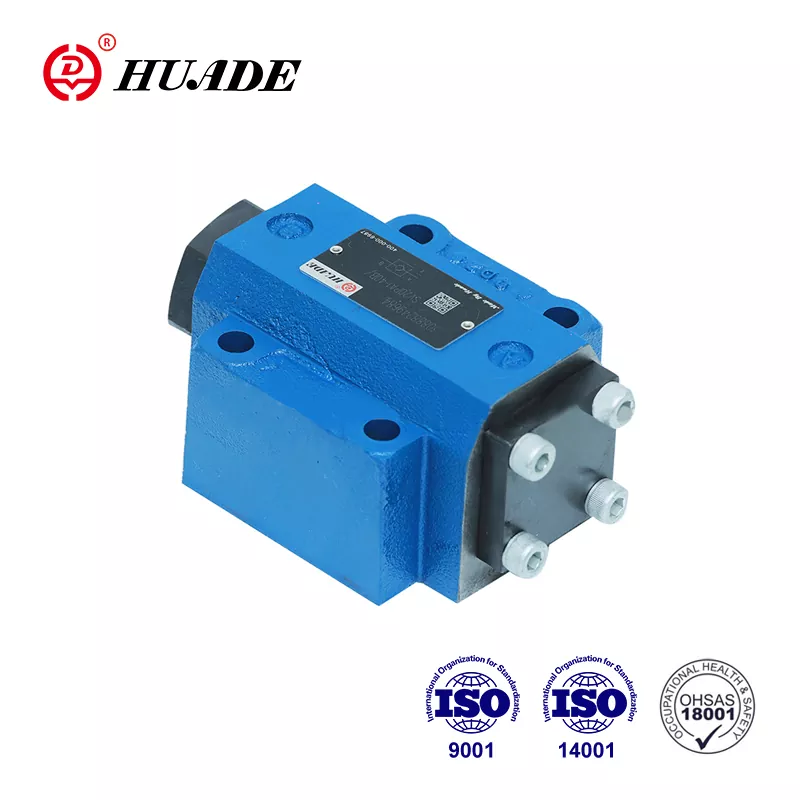
Have you ever wondered how water flows in only one direction through pipes? Or why your home’s plumbing doesn’t backflow into the water supply? The answer lies in a simple but clever device called a no return valve.
Also known as a check valve, one-way valve, or backflow preventer, this small but mighty component protects our water systems, industrial equipment, and homes from costly damage and contamination.
What Exactly is a No Return Valve?
Picture a no return valve as a one-way door for liquids and gases. Just like a turnstile at a subway station guides people in one direction, this clever device allows fluid to flow forward while automatically blocking reverse flow.
Here’s what it does: A no return valve automatically allows fluid to move in one direction while stopping it from flowing backward.
Key Features That Make It Special
- Operates without power – No switches, buttons, or electricity required
- Guards your system constantly – Provides 24/7 protection, even during blackouts
- Built for reliability – Fewer moving parts reduce failure risks
- Saves money – Prevents costly equipment breakdowns
How Do No Return Valves Work? Understanding Check Valve Working Principle
The magic happens through something called pressure differential. Don’t worry – it’s simpler than it sounds!
The Science Made Simple
When fluid flows forward:
- Pressure on the inlet (entry) side is higher than the outlet (exit) side
- This pressure difference pushes the valve’s closing part (like a disc or ball) away from its seat
- Fluid flows through freely
When flow stops or tries to reverse:
- The pressure equalizes or reverses
- Gravity, springs, or back-pressure pushes the closing part back against its seat
- The valve seals shut, blocking reverse flow
Simple analogy: It’s like a screen door with a spring – it opens when you push it, but automatically closes when you let go!
Main Parts of a No Return Valve
Every no return valve has these basic components:
- Valve Body: The outer shell that holds everything together
- Inlet and Outlet: Where fluid enters and exits
- Closing Element: The moving part (disc, ball, or diaphragm) that opens and closes
- Valve Seat: The surface where the closing element seals against
- Helper Mechanisms: Springs, hinges, or flexible materials that help it work
Types of Check Valves – Complete No Return Valve Selection Guide
Not all check valves are the same. Each no return valve type works best for different situations. Let’s explore the most common check valve types:
1. Swing Check Valve
How it works: A disc swings on a hinge like a door
Best for: Large water pipes, low-pressure systems
Pros
Low resistance to flow, simple design
Cons
Can make loud “banging” sounds when closing quickly
2. Ball Check Valve
How it works: A ball rolls away from the seat when flow starts
Best for: Small pumps, simple systems
Pros
Very simple and cheap
Cons
Needs regular cleaning, works best in small pipes
3. Lift Check Valve
How it works: A disc moves straight up and down like an elevator
Best for: High-pressure systems like steam pipes
Pros
Handles high pressure well
Cons
Creates more resistance to flow
4. Diaphragm Check Valve
How it works: A flexible rubber disc bends to open and close
Best for: Dirty water, chemical systems
Pros
Good with corrosive fluids, handles debris well
Cons
Limited to lower flow rates
5. Silent Check Valve
How it works: Uses springs to close gently before flow reverses
Best for: Quiet environments, hospitals, hotels
Pros
Very quiet operation, prevents water hammer
Cons
More expensive and complex
Real-world success:
A major pharmaceutical plant in New Jersey replaced their standard swing check valves with silent models after noise complaints. Result: 90% noise reduction + prevented water hammer damage.
6. Duckbill Check Valve
How it works: Looks like a duck’s bill that opens with flow and collapses shut
Best for: Wastewater, storm drains
Pros
No slamming, handles solids well
Cons
Made of rubber that can wear out
Success story:
Miami’s wastewater treatment facility installed duckbill valves in their main discharge lines. Result: 75% fewer maintenance calls + $200,000 annual savings.
Check Valve Applications: Where No Return Valves Are Used
These versatile check valves are everywhere! Here are the most common no return valve applications:
In Your Home
- Water heaters: Prevents hot water from flowing back into cold lines
- Sump pumps: Keeps water from flowing back into your basement
- Washing machines: Prevents dirty water from contaminating clean supply
Water Treatment Plants
- Pump stations: Protects pumps from damage
- Distribution systems: Keeps treated water from flowing backward
- Sewage systems: Prevents contamination of clean water
Industrial Applications
- Oil and gas: Protects expensive compressors and pipelines
- Chemical plants: Prevents dangerous chemical mixing
- Steam systems: Protects boilers from backflow damage
- HVAC systems: Maintains proper heating and cooling flow
Special Applications
- Fire sprinkler systems: Ensures water flows to where it’s needed
- Medical equipment: Prevents contamination in IV lines
- Food processing: Keeps different ingredients separated
Why Are No Return Valves So Important?
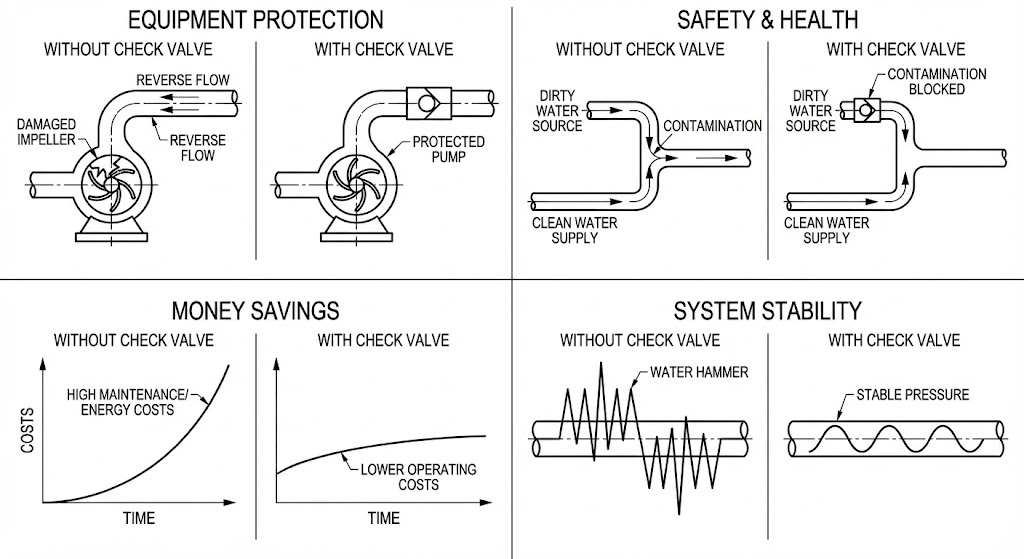
These simple devices provide huge benefits that save money and prevent disasters:
Equipment Protection
- Shields pumps from damage: Blocks reverse flow that destroys pump impellers
- Guards expensive meters: Keeps costly flow meters from spinning backward
- Protects compressors: Prevents expensive damage to air and gas compression equipment
Case example:
A Texas oil refinery avoided $500,000 in compressor repairs by installing high-quality check valves in their gas lines. The valves prevented reverse flow that would have destroyed three major compressors.
Safety and Health
- Blocks contamination: Keeps dirty water out of clean supplies
- Prevents cross-contamination: Separates different chemicals or fluids
- Protects drinking water: Essential for public health
Critical example: During Hurricane Katrina, properly installed backflow preventers protected thousands of New Orleans residents from waterborne diseases. These check valves prevented sewage contamination of drinking water supplies.
Money Savings
- Reduces energy costs: Prevents wasted pump energy
- Minimizes downtime: Less equipment failure means less lost production
- Lower maintenance: Prevents damage that requires expensive repairs
System Stability
Modern check valves prevent water hammer, reduce operational noise, and maintain optimal system pressure – ensuring smooth, reliable operation across all applications.
Check Valve Troubleshooting: Common No Return Valve Problems
Even the best check valves can have issues. Here’s your complete no return valve troubleshooting guide:
Problem 1: Noise and Banging
Symptoms: Loud “slam” when valve closes
Causes: Fast-closing valves or water hammer
- Switch to silent or duckbill valves
- Install water hammer arrestors
- Check system pressure settings
Field solution:
A Seattle hospital replaced noisy swing check valves with silent models after patient complaints. Investment: $15,000 upgrade. Result: Eliminated noise + prevented $80,000 in pipe damage.
Problem 2: Leaking or Reverse Flow
Symptoms: Water flowing backward, visible leaks
Causes: Worn seals, debris on seat, damaged disc
- Clean valve thoroughly
- Replace worn seals and gaskets
- Check for proper installation
Problem 3: Chattering or Vibration
Symptoms: Rapid opening/closing sounds, system vibration
Causes: Low flow rate, wrong valve size
- Increase flow rate if possible
- Replace with properly sized valve
- Check for partial blockages
Problem 4: Valve Won’t Open
Symptoms: No flow when there should be
Causes: Debris jamming valve, corrosion, wrong installation
- Clean valve internals
- Check installation direction (arrow should point with flow)
- Replace corroded components
Troubleshooting success:
A California food processing plant discovered their check valve was installed backward during a production shutdown. The 15-minute fix saved $50,000 in lost production.
No Return Valve Selection Guide: How to Choose the Right Check Valve
Selecting the perfect check valve for your needs involves considering several factors:
System Requirements
- Pressure rating: How much pressure will the valve see?
- Flow rate: How much fluid needs to pass through?
- Temperature: Will it be hot, cold, or changing?
- Pipe size: Match the valve to your pipe diameter
Fluid Properties
- Type of fluid: Water, oil, gas, chemicals?
- Cleanliness: Clean fluid or contains debris?
- Corrosiveness: Will it eat away at valve materials?
Performance Needs
- Noise tolerance: Quiet operation required?
- Response speed: How quickly must it close?
- Leakage acceptance: How tight must the seal be?
- Maintenance access: Easy to service or hard to reach?
Budget Considerations
- Initial cost: Purchase price
- Installation cost: Labor and fittings
- Operating cost: Energy lost to pressure drop
- Maintenance cost: Cleaning and replacement parts
Check Valve Installation and Maintenance Guide
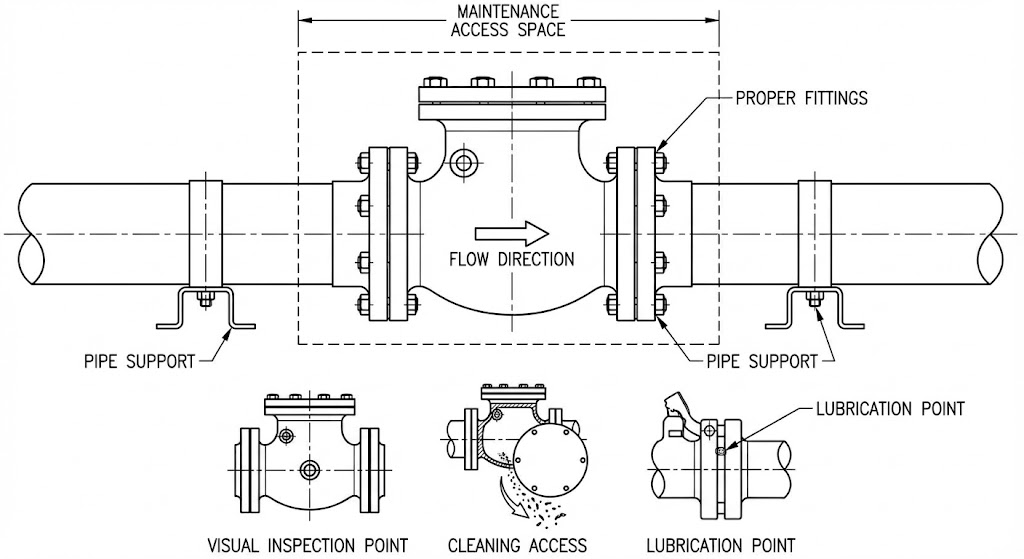
Proper Check Valve Installation
- Check the arrow: Flow direction arrow must point the right way
- Support the valve: Don’t let pipes support the valve’s weight
- Leave service space: Room to access for maintenance
- Use proper fittings: Match valve connections to your pipes
No Return Valve Maintenance Best Practices
- Visual inspection: Look for leaks, corrosion, or damage monthly
- Performance monitoring: Check if it’s working properly
- Cleaning: Remove debris from valve body and seat
- Lubrication: Apply appropriate lubricant to moving parts
When to Replace
- Visible cracks or severe corrosion
- Consistent leakage after cleaning
- Frequent chattering or noise
- Unable to stop reverse flow
Check Valve Standards and Industry Compliance
Professional check valve installations follow specific standards to ensure safety and performance:
- API 594: Standard for check valve design and testing (American Petroleum Institute)
- AWWA C508: Water utility check valve requirements (American Water Works Association)
- ASME B16.34: Pressure and temperature ratings for steel valves (American Society of Mechanical Engineers)
- ISO 5208: International valve testing procedures (International Organization for Standardization)
These industry standards ensure check valves will work safely and reliably in their intended applications.
Frequently Asked Questions About Check Valves and No Return Valves
Conclusion: Why No Return Valves Matter
No return valves appear simple, but they represent sophisticated engineering solutions that safeguard our water supplies, industrial equipment, and homes. Without these silent guardians, pumps would fail regularly, water systems would become contaminated, and entire facilities would shut down unexpectedly.
Whether you’re a homeowner trying to understand your plumbing, a student learning about fluid systems, or a professional selecting equipment, mastering no return valve principles helps you make smarter decisions and solve problems faster.
The essential points:
- These devices operate independently to stop reverse flow
- Multiple designs serve different needs and applications
- Smart selection prevents expensive failures